
WarpStream
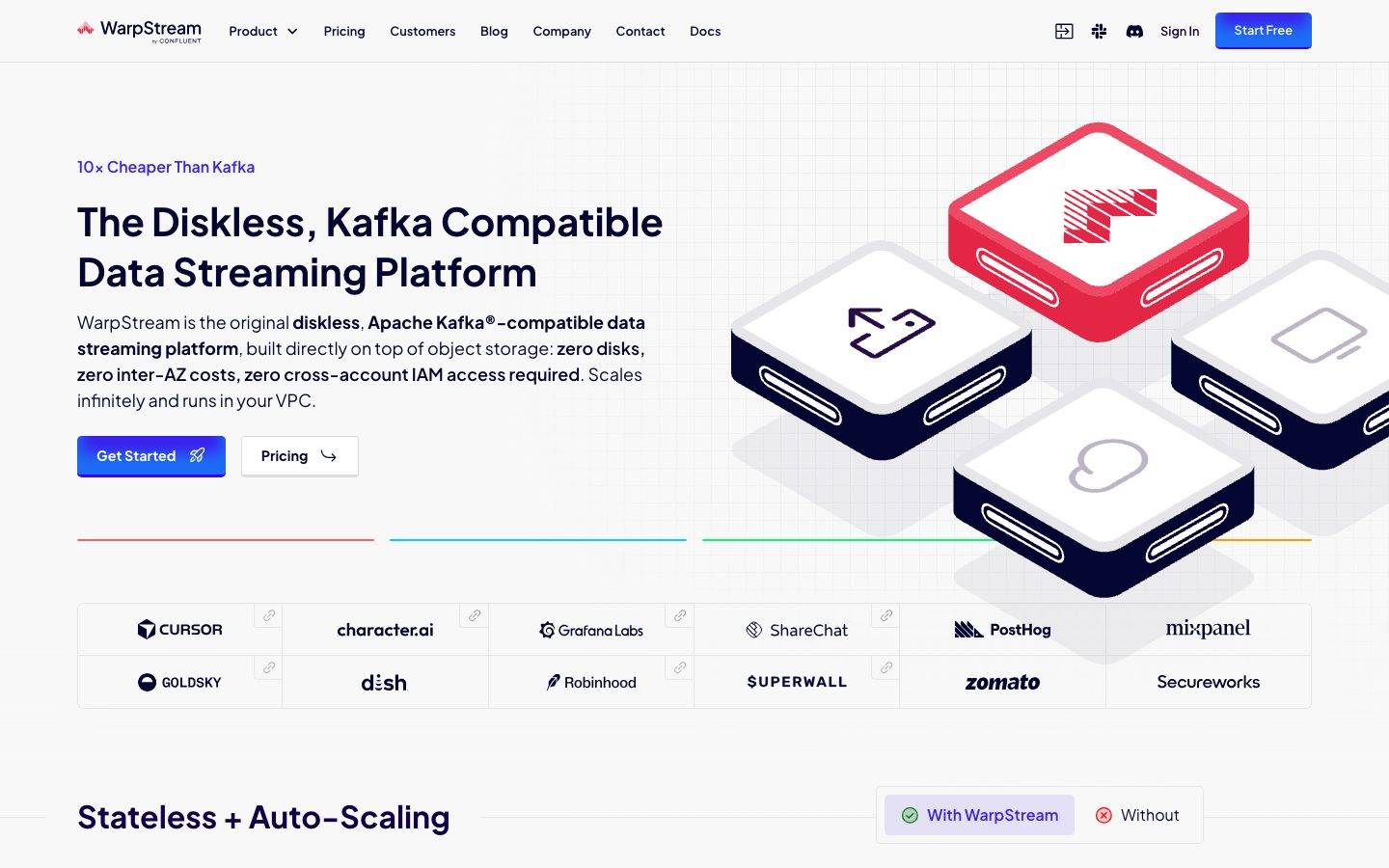
A developer-infrastructure marketing surface built on a near-white canvas (#f8f8f8) with deep-navy ink (#040531) and an electric indigo brand accent (#3a21ed). The system reads as confident, technical, and slightly maximal — bold Plus Jakarta Sans headlines, sharp-cornered indigo CTAs with hard offset shadows, isometric 3D product illustrations rendered in indigo/red/navy, and dark-navy terminal/code surfaces dropped into an otherwise light page. Brand voltage comes from the saturated indigo accent and the isometric "diskless" cube artwork rather than from decorative color washes.
Works withClaude CodeCursorCodexGemini CLICopilotv0LovableBoltWindsurfReplit
---
version: alpha
name: WarpStream-design-analysis
description: "A developer-infrastructure marketing surface built on a near-white canvas (#f8f8f8) with deep-navy ink (#040531) and an electric indigo brand accent (#3a21ed). The system reads as confident, technical, and slightly maximal — bold Plus Jakarta Sans headlines, sharp-cornered indigo CTAs with hard offset shadows, isometric 3D product illustrations rendered in indigo/red/navy, and dark-navy terminal/code surfaces dropped into an otherwise light page. Brand voltage comes from the saturated indigo accent and the isometric \"diskless\" cube artwork rather than from decorative color washes."

colors:
  primary: "#3a21ed"
  primary-deep: "#270b46"
  ink: "#040531"
  ink-soft: "#190430"
  navy-card: "#1a1a2e"
  body: "#333333"
  muted: "#969696"
  muted-soft: "#aaaaaa"
  canvas: "#f8f8f8"
  surface: "#ffffff"
  surface-fafafa: "#fafafa"
  surface-cream: "#fff8f0"
  hairline: "#dddddd"
  hairline-soft: "#eeeeee"
  hairline-strong: "#cccccc"
  dark: "#1a1a1a"
  dark-soft: "#222222"
  black: "#000000"
  on-primary: "#ffffff"
  cyan: "#21c8ed"
  red: "#e52344"

typography:
  display:
    fontFamily: "Plus Jakarta Sans, sans-serif"
    fontSize: 40px
    fontWeight: 700
    lineHeight: 1.2
    letterSpacing: 0px
  heading-xl:
    fontFamily: "Plus Jakarta Sans, sans-serif"
    fontSize: 40px
    fontWeight: 600
    lineHeight: 1.3
    letterSpacing: 0px
  heading:
    fontFamily: "Plus Jakarta Sans, sans-serif"
    fontSize: 32px
    fontWeight: 700
    lineHeight: 1.2
    letterSpacing: 0px
  body:
    fontFamily: "Plus Jakarta Sans, sans-serif"
    fontSize: 17.92px
    fontWeight: 400
    lineHeight: 1.5
    letterSpacing: 0px
  button:
    fontFamily: "Plus Jakarta Sans, sans-serif"
    fontSize: 12.8px
    fontWeight: 600
    lineHeight: 1.5
    letterSpacing: 0px

rounded:
  none: 0px
  xs: 4px
  sm: 6px
  md: 8px
  lg: 12px
  xl: 24px
  pill: 110px
  full: 9999px

spacing:
  xxs: 4px
  xs: 8px
  sm: 12px
  md: 16px
  lg: 20px
  xl: 24px

components:
  top-nav:
    backgroundColor: "{colors.canvas}"
    textColor: "{colors.ink}"
    typography: "{typography.body}"
  button-primary:
    backgroundColor: "{colors.primary}"
    textColor: "{colors.on-primary}"
    typography: "{typography.button}"
    rounded: "{rounded.none}"
    padding: 22.4px 12.8px
  button-secondary:
    backgroundColor: "{colors.surface}"
    textColor: "{colors.ink}"
    typography: "{typography.button}"
    rounded: "{rounded.none}"
    padding: 22.4px 12.8px
  eyebrow-label:
    backgroundColor: transparent
    textColor: "{colors.primary}"
    typography: "{typography.body}"
  card:
    backgroundColor: "{colors.canvas}"
    textColor: "{colors.ink}"
    rounded: "{rounded.sm}"
  feature-card:
    backgroundColor: "{colors.surface}"
    textColor: "{colors.ink}"
    typography: "{typography.body}"
    rounded: "{rounded.lg}"
  customer-logo-cell:
    backgroundColor: "{colors.surface}"
    textColor: "{colors.ink}"
    rounded: "{rounded.sm}"
  toggle-pill:
    backgroundColor: "{colors.surface-cream}"
    textColor: "{colors.ink}"
    typography: "{typography.button}"
    rounded: "{rounded.xl}"
  code-block:
    backgroundColor: "{colors.ink}"
    textColor: "{colors.on-primary}"
    typography: "{typography.body}"
    rounded: "{rounded.md}"
  terminal-block:
    backgroundColor: "{colors.ink}"
    textColor: "{colors.on-primary}"
    rounded: "{rounded.lg}"
  demo-callout:
    backgroundColor: "{colors.ink-soft}"
    textColor: "{colors.on-primary}"
    typography: "{typography.body}"
    rounded: "{rounded.md}"
  blog-card:
    backgroundColor: "{colors.surface}"
    textColor: "{colors.ink}"
    typography: "{typography.body}"
    rounded: "{rounded.lg}"
  faq-item:
    backgroundColor: "{colors.surface}"
    textColor: "{colors.ink}"
    typography: "{typography.body}"
  download-banner:
    backgroundColor: "{colors.primary}"
    textColor: "{colors.on-primary}"
    typography: "{typography.body}"
    rounded: "{rounded.md}"
  footer:
    backgroundColor: "{colors.canvas}"
    textColor: "{colors.body}"
    typography: "{typography.body}"
---

## Overview

WarpStream's marketing surface is a developer-infrastructure landing page built on a near-white canvas (`{colors.canvas}` — #f8f8f8) with deep-navy ink (`{colors.ink}` — #040531) and a single saturated electric-indigo brand accent (`{colors.primary}` — #3a21ed). The system reads as technical and confident — heavy Plus Jakarta Sans headlines, sharp-cornered indigo CTAs, and big isometric 3D "diskless" cube illustrations rendered in indigo, red (`{colors.red}` — #e52344), and navy.

The type voice is monolithic: **Plus Jakarta Sans** carries everything from the 40px hero headline down to the 12.8px button label. There is no secondary typeface — hierarchy is built entirely from weight (400 / 600 / 700) and size. Headlines run weight 700 at tight 1.2 line-height; body runs weight 400 at relaxed 1.5.

Component voltage comes from two places: the **isometric product artwork** (the stacked 3D cube diagram showing the "diskless" architecture) and the **dark-navy terminal/code surfaces** (`{colors.ink}` — #040531) that drop into the otherwise light page to show install commands and Kafka config. Marketing claims sit on white feature cards; the actual developer experience is shown in dark code chrome.

The page stays light end-to-end — there is no inverted dark footer. Instead, contrast is delivered locally via the navy code/terminal blocks and the indigo CTA + download banner.

**Key Characteristics:**
- Near-white canvas (`{colors.canvas}` — #f8f8f8) with deep-navy ink (`{colors.ink}` — #040531). White (`{colors.surface}` — #ffffff) is reserved for elevated cards and logo cells.
- Single electric-indigo accent (`{colors.primary}` — #3a21ed) for primary CTAs, eyebrow labels, and the download banner. The brand is essentially monochrome-plus-indigo.
- One typeface — **Plus Jakarta Sans** — across display, headings, body, and buttons. Hierarchy from weight + size only.
- Sharp-cornered primary buttons (`{rounded.none}` — 0px measured) with a hard offset drop shadow, giving a slightly retro/technical feel.
- Isometric 3D product illustration in indigo / red / navy as the hero artifact — the "diskless" cube stack is the brand's signature visual.
- Dark-navy code blocks and a terminal callout (`{colors.ink}` — #040531) embedded inline to show real install commands and Kafka config.
- A red→cyan→green→yellow multicolor hairline rule under the hero (cyan `{colors.cyan}` and red `{colors.red}` measured; green/yellow are in Known Gaps).
- Radius is hierarchical and modest for UI (`{rounded.sm}` 6px cards, `{rounded.lg}` 12px feature/blog cards) with very large pill radii (110px) reserved for decorative blob shapes.

## Colors

### Brand & Accent
- **Primary** (`{colors.primary}` — #3a21ed): The dominant action color. "Get Started" / "Start Free" CTAs, the eyebrow "10× Cheaper Than Kafka", inline links, and the download banner. This is the only saturated hue used at the action layer.
- **Primary Deep** (`{colors.primary-deep}` — #270b46): A deep purple used in isometric artwork shading and dark decorative fills.
- **Cyan** (`{colors.cyan}` — #21c8ed): A secondary accent appearing in the multicolor hero rule and in the terminal/demo glow. Used sparingly.
- **Red** (`{colors.red}` — #e52344): The red isometric cube face and one segment of the multicolor hero rule. A spot accent, never on CTAs.

### Surface
- **Canvas** (`{colors.canvas}` — #f8f8f8): The default page floor and footer background.
- **Surface** (`{colors.surface}` — #ffffff): Elevated cards, customer-logo cells, feature panels, FAQ rows.
- **Surface fafafa** (`{colors.surface-fafafa}` — #fafafa): A barely-cooler off-white used for nested panels.
- **Surface Cream** (`{colors.surface-cream}` — #fff8f0): The warm-tinted background of the "With WarpStream / Without" toggle pill.
- **Ink** (`{colors.ink}` — #040531): Deep navy used both as primary text and as the dark code/terminal surface fill.
- **Ink Soft** (`{colors.ink-soft}` — #190430): A near-black purple used in the developer demo callout and deeper dark panels.
- **Navy Card** (`{colors.navy-card}` — #1a1a2e): A dark navy variant used in nested dark UI fragments.
- **Dark / Dark Soft** (`{colors.dark}` — #1a1a1a, `{colors.dark-soft}` — #222222): Near-black neutrals used in artwork and icon strokes.
- **Black** (`{colors.black}` — #000000): Pure black, used minimally in iconography.

### Hairlines
- **Hairline** (`{colors.hairline}` — #dddddd): The default 1px divider tone — logo-grid cell borders, card outlines, section dividers.
- **Hairline Soft** (`{colors.hairline-soft}` — #eeeeee): A fainter divider between sections that share the canvas.
- **Hairline Strong** (`{colors.hairline-strong}` — #cccccc): A slightly heavier border tone for emphasis.

### Text
- **Ink** (`{colors.ink}` — #040531): All headlines and primary text.
- **Body** (`{colors.body}` — #333333): Default link / running-text color.
- **Muted** (`{colors.muted}` — #969696): Secondary text, captions, fine-print.
- **Muted Soft** (`{colors.muted-soft}` — #aaaaaa): Tertiary text, disabled labels.
- **On Primary** (`{colors.on-primary}` — #ffffff): Text on indigo CTAs, the download banner, and dark code/terminal surfaces.

## Typography

### Font Family
The system runs a single typeface — **Plus Jakarta Sans** — across every role. Plus Jakarta Sans is an open-source Google font (`fonts_licensed` is empty in the measured data), so no substitution is required; the fallback stack walks `Plus Jakarta Sans, sans-serif`. Hierarchy is built entirely from weight (400 body, 600 heading-xl / button, 700 display / heading) and size, not from a typeface pairing.

### Hierarchy

| Token | Size | Weight | Line Height | Letter Spacing | Use |
|---|---|---|---|---|---|
| `{typography.display}` | 40px | 700 | 1.2 | 0px | Hero h1 ("The Diskless, Kafka Compatible Data Streaming Platform") |
| `{typography.heading-xl}` | 40px | 600 | 1.3 | 0px | Large weight-600 section heads (h4 role) |
| `{typography.heading}` | 32px | 700 | 1.2 | 0px | Section heads ("Stateless + Auto-Scaling", "Kafka On Easy Mode") — h2/h3 |
| `{typography.body}` | 17.92px | 400 | 1.5 | 0px | Default running-text, intro paragraphs, nav, footer |
| `{typography.button}` | 12.8px | 600 | 1.5 | 0px | Button labels, toggle-pill labels |

Note: `{typography.body}` (17.92px) and `{typography.button}` (12.8px) are the exact computed pixel values (derived from rem-based sizing — these are the measured fractional sizes, not rounded).

### Principles
Because there is only one typeface, the boundary between hierarchy levels is purely weight + size. Display and h2/h3 share weight 700 at 1.2 line-height; the distinguishing move is the 40px vs 32px size. The 40px heading-xl role is the one exception — it uses the lighter weight 600 at a looser 1.3 line-height for a calmer large heading. Body text stays at weight 400 / 1.5 line-height for comfortable reading. Buttons are tiny (12.8px) but bold (600) — the label compensates for size with weight, not with letter-spacing (tracking stays at 0 everywhere).

## Layout

### Spacing System
- **Base unit:** 4px (the most frequent measured increments cluster on 4 / 8 / 16).
- **Tokens:** `{spacing.xxs}` 4px · `{spacing.xs}` 8px · `{spacing.sm}` 12px · `{spacing.md}` 16px · `{spacing.lg}` 20px · `{spacing.xl}` 24px.
- 16px is by far the most frequent gap (measured 72×), making it the workhorse for card padding and inter-element spacing; 6px (40×) and 11px (32×) appear for tighter inline padding.
- **Card internal padding:** clusters around 16–24px on feature and blog cards.

### Grid & Container
- **Hero:** Two-column split — headline + sub-copy + button row on the left, isometric cube artwork on the right.
- **Customer logo grid:** A 6-column × 2-row bordered logo wall (`{component.customer-logo-cell}`) directly below the hero.
- **Feature bands:** Alternating two-column text + product-illustration / code rows.
- **Blog grid:** 3-up "Latest From the Blog" cards.
- **FAQ:** Two-column — heading + CTA on the left, accordion list on the right.

### Whitespace Philosophy
The layout breathes generously between bands — large vertical gaps separate the hero, architecture diagram, feature panels, and blog grid. Within bands, content is moderately dense (16px is the dominant gap). The result reads as a confident technical-SaaS page: airy at the macro level, compact at the component level.

## Elevation & Depth

| Level | Treatment | Use |
|---|---|---|
| Flat | No shadow, hairline border (`{colors.hairline}`) | Logo cells, section dividers, FAQ rows |
| Soft layered | `rgba(42,51,69,0.04) 0 1px 1px` → `0 12px 12px -6px` multi-stop (measured, 14×) | Default card elevation — feature cards, blog cards |
| Hard offset | `rgba(0,0,0,0.1) 2px 2px 0 0` (measured, 4×) and `rgba(4,5,49,0.1) 10px 10px 0 0` (measured) | The signature sharp-cornered button + card offset shadow — a flat retro drop with no blur |
| Deep drop | `rgba(0,0,0,0.18) 0 24px 48px -12px` (measured, 4×) | Strongly elevated panels / floating UI |
| Inset glow | `rgba(0,183,255,0.51) 0 -17px 14px 5px inset` (measured, 5×) | Cyan glow on dark cube faces / terminal accents |

The elevation philosophy mixes **soft modern layered shadows** for content cards with a **hard zero-blur offset shadow** for buttons and emphasis cards — that flat offset is part of the brand's slightly retro-technical voice. The inset cyan glow is reserved for the dark isometric artwork and terminal surfaces.

### Decorative Depth
- The isometric 3D cube stack (the "diskless" architecture diagram) carries its own rendered depth in indigo / red / navy — it is illustration, not a system token.
- The multicolor hairline rule under the hero (red `{colors.red}` → cyan `{colors.cyan}` → green → yellow) is a thin decorative divider; only the red and cyan segments are confirmed in the measured palette.

## Shapes

### Border Radius Scale

| Token | Value | Use |
|---|---|---|
| `{rounded.none}` | 0px | Primary + secondary buttons (measured 0px on the button component) |
| `{rounded.xs}` | 4px | Small inline chips, badges (measured 18×) |
| `{rounded.sm}` | 6px | Default cards, logo cells (measured 20× — the most common radius) |
| `{rounded.md}` | 8px | Code blocks, mid-size panels |
| `{rounded.lg}` | 12px | Feature cards, blog cards, terminal block |
| `{rounded.xl}` | 24px | Toggle pill, large rounded containers |
| `{rounded.pill}` | 110px | Large decorative blob shapes / pill artwork (measured 110px, 4×) |
| `{rounded.full}` | 9999px | Fully circular elements (measured 9999px, 1×) |

### Geometry Notes
The system pairs **sharp 0px corners on buttons** with **softly rounded 6–12px corners on cards** — a deliberate tension that gives CTAs a more "engineered" edge while content surfaces stay friendly. Very large radii (60 / 70 / 110px, measured) belong to decorative blob/pill artwork rather than UI chrome.

## Components

### Navigation

**`top-nav`** — Light nav bar pinned to the top of the page. Background `{colors.canvas}`, text `{colors.ink}`, type `{typography.body}`. Carries the WarpStream wordmark + "by Confluent" lockup at left, a horizontal menu (Product ▾, Pricing, Customers, Blog, Company, Contact, Docs) center, and a right cluster with social/icon links, a "Sign In" text link, and a `{component.button-primary}` "Start Free".

### Buttons

**`button-primary`** — The signature indigo CTA ("Get Started" / "Start Free"). Background `{colors.primary}` (#3a21ed), text `{colors.on-primary}`, type `{typography.button}` (Plus Jakarta Sans 12.8px / 600), padding 22.4px × 12.8px, radius `{rounded.none}` (0px, measured). Carries the hard offset drop shadow (`rgba(0,0,0,0.1) 2px 2px 0 0`). Often paired with a small inline icon (rocket / arrow).

**`button-secondary`** — White outline button ("Pricing"). Background `{colors.surface}`, text `{colors.ink}`, hairline border (`{colors.hairline}`), same padding + radius as primary. Paired beside the primary CTA in the hero.

### Labels

**`eyebrow-label`** — Small indigo kicker above headlines ("10× Cheaper Than Kafka", "Operationally Simple", "Made for Developers"). Transparent background, text `{colors.primary}`, type `{typography.body}`.

### Cards & Containers

**`card`** — Base card surface. Background `{colors.canvas}`, radius `{rounded.sm}` (6px), no shadow (per measured `card` component).

**`feature-card`** — Elevated content card used in feature bands ("Kafka On Easy Mode", "Plug & Play Kafka", "Bring Your Own Cloud"). Background `{colors.surface}` (#ffffff), text `{colors.ink}`, type `{typography.body}`, radius `{rounded.lg}` (12px), soft layered shadow.

**`customer-logo-cell`** — A bordered cell in the customer logo wall (Cursor, character.ai, Grafana, ShareChat, PostHog, Mixpanel, etc.). Background `{colors.surface}`, hairline border (`{colors.hairline}`), radius `{rounded.sm}`. Some cells carry a small external-link glyph in the corner.

**`toggle-pill`** — The "With WarpStream / Without" comparison switch. Background `{colors.surface-cream}` (#fff8f0), text `{colors.ink}`, type `{typography.button}`, radius `{rounded.xl}` (24px). The active "With WarpStream" segment carries a green check glyph; "Without" carries a red glyph.

**`blog-card`** — "Latest From the Blog" card. Background `{colors.surface}`, text `{colors.ink}`, type `{typography.body}`, radius `{rounded.lg}`. Carries an author avatar + name + date row at top, a headline, a short excerpt, and a "Read More" link.

### Code & Developer Surfaces

**`code-block`** — Inline dark config block showing Kafka producer config. Background `{colors.ink}` (#040531), text `{colors.on-primary}`, type `{typography.body}`, radius `{rounded.md}` (8px). Monospace rendering is product chrome, not a declared token.

**`terminal-block`** — A larger faux-terminal panel ("warpstream — zsh") with traffic-light dots. Background `{colors.ink}`, text `{colors.on-primary}`, radius `{rounded.lg}`. Used to show install commands.

**`demo-callout`** — The "Made for Developers — Try our demo in under 30 seconds" box nested inside the terminal, with the `curl https://...install.sh | sh` command. Background `{colors.ink-soft}` (#190430), text `{colors.on-primary}`, type `{typography.body}`, radius `{rounded.md}`, with a cyan accent border / glow (`{colors.cyan}`).

### FAQ & Banners

**`faq-item`** — Accordion row in the FAQ band. Background `{colors.surface}`, text `{colors.ink}`, type `{typography.body}`, with a `+` expand glyph at right and a hairline divider (`{colors.hairline}`) between rows.

**`download-banner`** — The full-width indigo "WarpStream Executive Summary" call-to-action strip. Background `{colors.primary}`, text `{colors.on-primary}`, type `{typography.body}`, radius `{rounded.md}`, with a "Download" action at right.

### Footer

**`footer`** — Light footer that closes the page on the canvas tone. Background `{colors.canvas}`, text `{colors.body}`, type `{typography.body}`. There is no inverted dark footer — the page stays light end-to-end, with the navy code/terminal blocks providing the only large dark surfaces.

## Do's and Don'ts

### Do
- Reserve `{colors.primary}` (#3a21ed) for primary CTAs, eyebrow labels, the download banner, and inline links. WarpStream is monochrome-plus-indigo.
- Use Plus Jakarta Sans everywhere; build hierarchy from weight (400 / 600 / 700) and size, not from a second typeface.
- Keep primary buttons sharp-cornered (`{rounded.none}`) with the hard offset shadow. That flat zero-blur drop is the brand's signature.
- Use white (`{colors.surface}`) cards on the `{colors.canvas}` (#f8f8f8) floor to signal elevation — the off-white-on-white relationship is the elevation cue.
- Show real developer experience in dark `{colors.ink}` code/terminal surfaces — install commands and Kafka config belong in dark chrome, marketing claims belong on white cards.
- Let the isometric cube artwork carry the visual voltage; the page palette stays restrained around it.

### Don't
- Don't introduce a second accent at the action layer — cyan (`{colors.cyan}`) and red (`{colors.red}`) are spot/illustration accents, never CTA fills.
- Don't round the primary button corners; the 0px edge is intentional.
- Don't invert the footer to a dark surface — contrast lives locally in the code/terminal blocks, not in a closing dark band.
- Don't mix weight 700 into body copy; body stays at weight 400 / 1.5 line-height.
- Don't apply the hard offset shadow and the soft layered shadow to the same element — buttons/emphasis use the offset; content cards use the soft layered stack.
- Don't add hover-state styling beyond the system's default/active treatment.

## Responsive Behavior

### Breakpoints
The two captured pages confirm a desktop layout and a tall single-column stacked composite. Specific breakpoint widths were not measured.

| Name | Behavior (observed / inferred) |
|---|---|
| Mobile | Nav likely collapses; hero stacks headline + copy + buttons above the isometric artwork; logo wall reflows to fewer columns; feature bands stack to single column; blog grid 3-up → 1-up |
| Tablet | Two-column feature bands tighten; logo wall reduces columns; toggle pill stays inline |
| Desktop | Full horizontal nav; two-column hero; 6-column logo wall; alternating two-column feature bands; 3-up blog grid |

### Touch Targets
- `{component.button-primary}` uses 22.4px × 12.8px padding around a 12.8px label — comfortably above minimum tap size with padding included.
- `{component.faq-item}` rows are full-width tap targets with a `+` affordance at right.
- Exact mobile target sizing was not measured — see Known Gaps.

### Collapsing Strategy
- Hero collapses from a two-column text/artwork split to a single column with artwork below the copy.
- The customer logo wall reduces from 6 columns toward 2–3 on narrow viewports.
- Alternating feature bands (text + illustration / code) stack vertically.
- The FAQ two-column layout collapses to a single stacked column.

## Iteration Guide

1. Focus on ONE component at a time. Reference its YAML key directly (`{component.feature-card}`, `{component.terminal-block}`).
2. Variants of an existing component (`-active`, `-disabled`, `-focused`) live as separate entries in `components:`.
3. Use `{token.refs}` everywhere — never inline a hex.
4. Never document hover. Default and Active/Pressed states only.
5. Hierarchy comes from weight + size in one typeface — when in doubt, go bigger or heavier in Plus Jakarta Sans rather than reaching for a new font.
6. The indigo accent is scarce by design — adding a second action color breaks the brand.
7. Keep the button edge sharp (`{rounded.none}`) and the card edge soft (`{rounded.sm}`/`{rounded.lg}`); that tension is intentional.

## Known Gaps

- The measured `button-primary` component reports `color: #040531` and `radius: 0px` from `computed:button` — this is the dark-text/outline button reading. The visible hero "Get Started" / "Start Free" CTA is indigo (`{colors.primary}`) with white text; the primary button is documented from screenshot ground-truth combined with the measured padding and 0px radius. The exact CTA radius (screenshots appear slightly softened) could not be confirmed beyond the measured 0px.
- The multicolor hero divider rule includes green and yellow segments visible in the screenshot, but only red (`{colors.red}`) and cyan (`{colors.cyan}`) were captured in the palette — the green and yellow hex values are not measured.
- No dedicated nav-link, eyebrow, or caption typography role was measured; nav and label text are documented against `{typography.body}` as the nearest measured role.
- Letter-spacing reported as "normal" for all roles; documented as 0px.
- Large radii of 20px, 60px, and 70px were measured but not assigned dedicated tokens — they belong to decorative/pill artwork and are folded into the nearest scale steps.
- Mobile and tablet breakpoint widths, touch-target minimums, and the responsive logo-wall column counts are inferred from the stacked composite screenshot, not measured.
- Animation/transition timings (toggle switch, FAQ accordion expand, terminal typing) are out of scope.
- Pricing-page-specific components (pricing tier cards) were not present in the component measurements and are not documented.
- Form/input states (text inputs, validation) were not extracted — the captured pages contain no form surfaces.

<!-- Documented by Duply · real-world design systems as ready-to-use DESIGN.md for AI coding agents · https://duply.ai/warpstream/design-md -->
Color Palette
Accent
Neutrals
Typography
display40px · 700 · 1.2
The quick brown fox jumpsheading-xl40px · 600 · 1.3
The quick brown fox jumpsheading32px · 700 · 1.2
The quick brown fox jumpsbody17.92px · 400 · 1.5
The quick brown fox jumpsbutton12.8px · 600 · 1.5
The quick brown fox jumpsSpacing & Shape
Spacing
| Name | Value | Preview |
|---|---|---|
| xxs | 4px | |
| xs | 8px | |
| sm | 12px | |
| md | 16px | |
| lg | 20px | |
| xl | 24px |
Border Radius
| Name | Value | Preview |
|---|---|---|
| none | 0px | |
| xs | 4px | |
| sm | 6px | |
| md | 8px | |
| lg | 12px | |
| xl | 24px | |
| pill | 110px | |
| full | 9999px |
FAQ
- What colors does WarpStream use?
- WarpStream's core palette includes #3a21ed, #270b46, #040531, #190430, #1a1a2e. The full color set with usage roles (canvas, ink, surfaces, accent, semantic) is documented in the WarpStream DESIGN.md.
- What font does WarpStream use?
- WarpStream's primary typeface is Plus Jakarta Sans. The complete type scale (sizes, weights, line-height and letter-spacing per role), with an open substitute where the original is licensed, is documented in the DESIGN.md.
- What is the WarpStream design system?
- A developer-infrastructure marketing surface built on a near-white canvas (#f8f8f8) with deep-navy ink (#040531) and an electric indigo brand accent (#3a21ed). The system reads as confident, technical, and slightly maximal — bold Plus Jakarta Sans headlines, sharp-cornered indigo CTAs with hard
Get this as a working kit
WarpStream Launch Kit + DESIGN.md
$299$225
One-time payment
- A complete production-stack template, styled like WarpStream, fully built and wired.
- One-time payment and the codebase is yours. No platform fees, no subscription.
Open it with Claude Code, Cursor, or any coding agent and build in plain language, then ship a complete web app.
- Your private DESIGN.md
- Marketing pages, blog, SEO & legal
- Email capture, newsletter & contact
- Accept payments (Stripe)
- Analytics (GA4 + PostHog)
- One-click deploy
- Auth, login & roles
- A full app dashboard, when you grow
More like this

---
version: alpha
name: WarpStream-design-analysis
description: "A developer-infrastructure marketing surface built on a near-white canvas (#f8f8f8) with deep-navy ink (#040531) and an electric indigo brand accent (#3a21ed). The system reads as confident, technical, and slightly maximal — bold Plus Jakarta Sans headlines, sharp-cornered indigo CTAs with hard offset shadows, isometric 3D product illustrations rendered in indigo/red/navy, and dark-navy terminal/code surfaces dropped into an otherwise light page. Brand voltage comes from the saturated indigo accent and the isometric \"diskless\" cube artwork rather than from decorative color washes."

colors:
  primary: "#3a21ed"
  primary-deep: "#270b46"
  ink: "#040531"
  ink-soft: "#190430"
  navy-card: "#1a1a2e"
  body: "#333333"
  muted: "#969696"
  muted-soft: "#aaaaaa"
  canvas: "#f8f8f8"
  surface: "#ffffff"
  surface-fafafa: "#fafafa"
  surface-cream: "#fff8f0"
  hairline: "#dddddd"
  hairline-soft: "#eeeeee"
  hairline-strong: "#cccccc"
  dark: "#1a1a1a"
  dark-soft: "#222222"
  black: "#000000"
  on-primary: "#ffffff"
  cyan: "#21c8ed"
  red: "#e52344"

typography:
  display:
    fontFamily: "Plus Jakarta Sans, sans-serif"
    fontSize: 40px
    fontWeight: 700
    lineHeight: 1.2
    letterSpacing: 0px
  heading-xl:
    fontFamily: "Plus Jakarta Sans, sans-serif"
    fontSize: 40px
    fontWeight: 600
    lineHeight: 1.3
    letterSpacing: 0px
  heading:
    fontFamily: "Plus Jakarta Sans, sans-serif"
    fontSize: 32px
    fontWeight: 700
    lineHeight: 1.2
    letterSpacing: 0px
  body:
    fontFamily: "Plus Jakarta Sans, sans-serif"
    fontSize: 17.92px
    fontWeight: 400
    lineHeight: 1.5
    letterSpacing: 0px
  button:
    fontFamily: "Plus Jakarta Sans, sans-serif"
    fontSize: 12.8px
    fontWeight: 600
    lineHeight: 1.5
    letterSpacing: 0px

rounded:
  none: 0px
  xs: 4px
  sm: 6px
  md: 8px
  lg: 12px
  xl: 24px
  pill: 110px
  full: 9999px

spacing:
  xxs: 4px
  xs: 8px
  sm: 12px
  md: 16px
  lg: 20px
  xl: 24px

components:
  top-nav:
    backgroundColor: "{colors.canvas}"
    textColor: "{colors.ink}"
    typography: "{typography.body}"
  button-primary:
    backgroundColor: "{colors.primary}"
    textColor: "{colors.on-primary}"
    typography: "{typography.button}"
    rounded: "{rounded.none}"
    padding: 22.4px 12.8px
  button-secondary:
    backgroundColor: "{colors.surface}"
    textColor: "{colors.ink}"
    typography: "{typography.button}"
    rounded: "{rounded.none}"
    padding: 22.4px 12.8px
  eyebrow-label:
    backgroundColor: transparent
    textColor: "{colors.primary}"
    typography: "{typography.body}"
  card:
    backgroundColor: "{colors.canvas}"
    textColor: "{colors.ink}"
    rounded: "{rounded.sm}"
  feature-card:
    backgroundColor: "{colors.surface}"
    textColor: "{colors.ink}"
    typography: "{typography.body}"
    rounded: "{rounded.lg}"
  customer-logo-cell:
    backgroundColor: "{colors.surface}"
    textColor: "{colors.ink}"
    rounded: "{rounded.sm}"
  toggle-pill:
    backgroundColor: "{colors.surface-cream}"
    textColor: "{colors.ink}"
    typography: "{typography.button}"
    rounded: "{rounded.xl}"
  code-block:
    backgroundColor: "{colors.ink}"
    textColor: "{colors.on-primary}"
    typography: "{typography.body}"
    rounded: "{rounded.md}"
  terminal-block:
    backgroundColor: "{colors.ink}"
    textColor: "{colors.on-primary}"
    rounded: "{rounded.lg}"
  demo-callout:
    backgroundColor: "{colors.ink-soft}"
    textColor: "{colors.on-primary}"
    typography: "{typography.body}"
    rounded: "{rounded.md}"
  blog-card:
    backgroundColor: "{colors.surface}"
    textColor: "{colors.ink}"
    typography: "{typography.body}"
    rounded: "{rounded.lg}"
  faq-item:
    backgroundColor: "{colors.surface}"
    textColor: "{colors.ink}"
    typography: "{typography.body}"
  download-banner:
    backgroundColor: "{colors.primary}"
    textColor: "{colors.on-primary}"
    typography: "{typography.body}"
    rounded: "{rounded.md}"
  footer:
    backgroundColor: "{colors.canvas}"
    textColor: "{colors.body}"
    typography: "{typography.body}"
---

## Overview

WarpStream's marketing surface is a developer-infrastructure landing page built on a near-white canvas (`{colors.canvas}` — #f8f8f8) with deep-navy ink (`{colors.ink}` — #040531) and a single saturated electric-indigo brand accent (`{colors.primary}` — #3a21ed). The system reads as technical and confident — heavy Plus Jakarta Sans headlines, sharp-cornered indigo CTAs, and big isometric 3D "diskless" cube illustrations rendered in indigo, red (`{colors.red}` — #e52344), and navy.

The type voice is monolithic: **Plus Jakarta Sans** carries everything from the 40px hero headline down to the 12.8px button label. There is no secondary typeface — hierarchy is built entirely from weight (400 / 600 / 700) and size. Headlines run weight 700 at tight 1.2 line-height; body runs weight 400 at relaxed 1.5.

Component voltage comes from two places: the **isometric product artwork** (the stacked 3D cube diagram showing the "diskless" architecture) and the **dark-navy terminal/code surfaces** (`{colors.ink}` — #040531) that drop into the otherwise light page to show install commands and Kafka config. Marketing claims sit on white feature cards; the actual developer experience is shown in dark code chrome.

The page stays light end-to-end — there is no inverted dark footer. Instead, contrast is delivered locally via the navy code/terminal blocks and the indigo CTA + download banner.

**Key Characteristics:**
- Near-white canvas (`{colors.canvas}` — #f8f8f8) with deep-navy ink (`{colors.ink}` — #040531). White (`{colors.surface}` — #ffffff) is reserved for elevated cards and logo cells.
- Single electric-indigo accent (`{colors.primary}` — #3a21ed) for primary CTAs, eyebrow labels, and the download banner. The brand is essentially monochrome-plus-indigo.
- One typeface — **Plus Jakarta Sans** — across display, headings, body, and buttons. Hierarchy from weight + size only.
- Sharp-cornered primary buttons (`{rounded.none}` — 0px measured) with a hard offset drop shadow, giving a slightly retro/technical feel.
- Isometric 3D product illustration in indigo / red / navy as the hero artifact — the "diskless" cube stack is the brand's signature visual.
- Dark-navy code blocks and a terminal callout (`{colors.ink}` — #040531) embedded inline to show real install commands and Kafka config.
- A red→cyan→green→yellow multicolor hairline rule under the hero (cyan `{colors.cyan}` and red `{colors.red}` measured; green/yellow are in Known Gaps).
- Radius is hierarchical and modest for UI (`{rounded.sm}` 6px cards, `{rounded.lg}` 12px feature/blog cards) with very large pill radii (110px) reserved for decorative blob shapes.

## Colors

### Brand & Accent
- **Primary** (`{colors.primary}` — #3a21ed): The dominant action color. "Get Started" / "Start Free" CTAs, the eyebrow "10× Cheaper Than Kafka", inline links, and the download banner. This is the only saturated hue used at the action layer.
- **Primary Deep** (`{colors.primary-deep}` — #270b46): A deep purple used in isometric artwork shading and dark decorative fills.
- **Cyan** (`{colors.cyan}` — #21c8ed): A secondary accent appearing in the multicolor hero rule and in the terminal/demo glow. Used sparingly.
- **Red** (`{colors.red}` — #e52344): The red isometric cube face and one segment of the multicolor hero rule. A spot accent, never on CTAs.

### Surface
- **Canvas** (`{colors.canvas}` — #f8f8f8): The default page floor and footer background.
- **Surface** (`{colors.surface}` — #ffffff): Elevated cards, customer-logo cells, feature panels, FAQ rows.
- **Surface fafafa** (`{colors.surface-fafafa}` — #fafafa): A barely-cooler off-white used for nested panels.
- **Surface Cream** (`{colors.surface-cream}` — #fff8f0): The warm-tinted background of the "With WarpStream / Without" toggle pill.
- **Ink** (`{colors.ink}` — #040531): Deep navy used both as primary text and as the dark code/terminal surface fill.
- **Ink Soft** (`{colors.ink-soft}` — #190430): A near-black purple used in the developer demo callout and deeper dark panels.
- **Navy Card** (`{colors.navy-card}` — #1a1a2e): A dark navy variant used in nested dark UI fragments.
- **Dark / Dark Soft** (`{colors.dark}` — #1a1a1a, `{colors.dark-soft}` — #222222): Near-black neutrals used in artwork and icon strokes.
- **Black** (`{colors.black}` — #000000): Pure black, used minimally in iconography.

### Hairlines
- **Hairline** (`{colors.hairline}` — #dddddd): The default 1px divider tone — logo-grid cell borders, card outlines, section dividers.
- **Hairline Soft** (`{colors.hairline-soft}` — #eeeeee): A fainter divider between sections that share the canvas.
- **Hairline Strong** (`{colors.hairline-strong}` — #cccccc): A slightly heavier border tone for emphasis.

### Text
- **Ink** (`{colors.ink}` — #040531): All headlines and primary text.
- **Body** (`{colors.body}` — #333333): Default link / running-text color.
- **Muted** (`{colors.muted}` — #969696): Secondary text, captions, fine-print.
- **Muted Soft** (`{colors.muted-soft}` — #aaaaaa): Tertiary text, disabled labels.
- **On Primary** (`{colors.on-primary}` — #ffffff): Text on indigo CTAs, the download banner, and dark code/terminal surfaces.

## Typography

### Font Family
The system runs a single typeface — **Plus Jakarta Sans** — across every role. Plus Jakarta Sans is an open-source Google font (`fonts_licensed` is empty in the measured data), so no substitution is required; the fallback stack walks `Plus Jakarta Sans, sans-serif`. Hierarchy is built entirely from weight (400 body, 600 heading-xl / button, 700 display / heading) and size, not from a typeface pairing.

### Hierarchy

| Token | Size | Weight | Line Height | Letter Spacing | Use |
|---|---|---|---|---|---|
| `{typography.display}` | 40px | 700 | 1.2 | 0px | Hero h1 ("The Diskless, Kafka Compatible Data Streaming Platform") |
| `{typography.heading-xl}` | 40px | 600 | 1.3 | 0px | Large weight-600 section heads (h4 role) |
| `{typography.heading}` | 32px | 700 | 1.2 | 0px | Section heads ("Stateless + Auto-Scaling", "Kafka On Easy Mode") — h2/h3 |
| `{typography.body}` | 17.92px | 400 | 1.5 | 0px | Default running-text, intro paragraphs, nav, footer |
| `{typography.button}` | 12.8px | 600 | 1.5 | 0px | Button labels, toggle-pill labels |

Note: `{typography.body}` (17.92px) and `{typography.button}` (12.8px) are the exact computed pixel values (derived from rem-based sizing — these are the measured fractional sizes, not rounded).

### Principles
Because there is only one typeface, the boundary between hierarchy levels is purely weight + size. Display and h2/h3 share weight 700 at 1.2 line-height; the distinguishing move is the 40px vs 32px size. The 40px heading-xl role is the one exception — it uses the lighter weight 600 at a looser 1.3 line-height for a calmer large heading. Body text stays at weight 400 / 1.5 line-height for comfortable reading. Buttons are tiny (12.8px) but bold (600) — the label compensates for size with weight, not with letter-spacing (tracking stays at 0 everywhere).

## Layout

### Spacing System
- **Base unit:** 4px (the most frequent measured increments cluster on 4 / 8 / 16).
- **Tokens:** `{spacing.xxs}` 4px · `{spacing.xs}` 8px · `{spacing.sm}` 12px · `{spacing.md}` 16px · `{spacing.lg}` 20px · `{spacing.xl}` 24px.
- 16px is by far the most frequent gap (measured 72×), making it the workhorse for card padding and inter-element spacing; 6px (40×) and 11px (32×) appear for tighter inline padding.
- **Card internal padding:** clusters around 16–24px on feature and blog cards.

### Grid & Container
- **Hero:** Two-column split — headline + sub-copy + button row on the left, isometric cube artwork on the right.
- **Customer logo grid:** A 6-column × 2-row bordered logo wall (`{component.customer-logo-cell}`) directly below the hero.
- **Feature bands:** Alternating two-column text + product-illustration / code rows.
- **Blog grid:** 3-up "Latest From the Blog" cards.
- **FAQ:** Two-column — heading + CTA on the left, accordion list on the right.

### Whitespace Philosophy
The layout breathes generously between bands — large vertical gaps separate the hero, architecture diagram, feature panels, and blog grid. Within bands, content is moderately dense (16px is the dominant gap). The result reads as a confident technical-SaaS page: airy at the macro level, compact at the component level.

## Elevation & Depth

| Level | Treatment | Use |
|---|---|---|
| Flat | No shadow, hairline border (`{colors.hairline}`) | Logo cells, section dividers, FAQ rows |
| Soft layered | `rgba(42,51,69,0.04) 0 1px 1px` → `0 12px 12px -6px` multi-stop (measured, 14×) | Default card elevation — feature cards, blog cards |
| Hard offset | `rgba(0,0,0,0.1) 2px 2px 0 0` (measured, 4×) and `rgba(4,5,49,0.1) 10px 10px 0 0` (measured) | The signature sharp-cornered button + card offset shadow — a flat retro drop with no blur |
| Deep drop | `rgba(0,0,0,0.18) 0 24px 48px -12px` (measured, 4×) | Strongly elevated panels / floating UI |
| Inset glow | `rgba(0,183,255,0.51) 0 -17px 14px 5px inset` (measured, 5×) | Cyan glow on dark cube faces / terminal accents |

The elevation philosophy mixes **soft modern layered shadows** for content cards with a **hard zero-blur offset shadow** for buttons and emphasis cards — that flat offset is part of the brand's slightly retro-technical voice. The inset cyan glow is reserved for the dark isometric artwork and terminal surfaces.

### Decorative Depth
- The isometric 3D cube stack (the "diskless" architecture diagram) carries its own rendered depth in indigo / red / navy — it is illustration, not a system token.
- The multicolor hairline rule under the hero (red `{colors.red}` → cyan `{colors.cyan}` → green → yellow) is a thin decorative divider; only the red and cyan segments are confirmed in the measured palette.

## Shapes

### Border Radius Scale

| Token | Value | Use |
|---|---|---|
| `{rounded.none}` | 0px | Primary + secondary buttons (measured 0px on the button component) |
| `{rounded.xs}` | 4px | Small inline chips, badges (measured 18×) |
| `{rounded.sm}` | 6px | Default cards, logo cells (measured 20× — the most common radius) |
| `{rounded.md}` | 8px | Code blocks, mid-size panels |
| `{rounded.lg}` | 12px | Feature cards, blog cards, terminal block |
| `{rounded.xl}` | 24px | Toggle pill, large rounded containers |
| `{rounded.pill}` | 110px | Large decorative blob shapes / pill artwork (measured 110px, 4×) |
| `{rounded.full}` | 9999px | Fully circular elements (measured 9999px, 1×) |

### Geometry Notes
The system pairs **sharp 0px corners on buttons** with **softly rounded 6–12px corners on cards** — a deliberate tension that gives CTAs a more "engineered" edge while content surfaces stay friendly. Very large radii (60 / 70 / 110px, measured) belong to decorative blob/pill artwork rather than UI chrome.

## Components

### Navigation

**`top-nav`** — Light nav bar pinned to the top of the page. Background `{colors.canvas}`, text `{colors.ink}`, type `{typography.body}`. Carries the WarpStream wordmark + "by Confluent" lockup at left, a horizontal menu (Product ▾, Pricing, Customers, Blog, Company, Contact, Docs) center, and a right cluster with social/icon links, a "Sign In" text link, and a `{component.button-primary}` "Start Free".

### Buttons

**`button-primary`** — The signature indigo CTA ("Get Started" / "Start Free"). Background `{colors.primary}` (#3a21ed), text `{colors.on-primary}`, type `{typography.button}` (Plus Jakarta Sans 12.8px / 600), padding 22.4px × 12.8px, radius `{rounded.none}` (0px, measured). Carries the hard offset drop shadow (`rgba(0,0,0,0.1) 2px 2px 0 0`). Often paired with a small inline icon (rocket / arrow).

**`button-secondary`** — White outline button ("Pricing"). Background `{colors.surface}`, text `{colors.ink}`, hairline border (`{colors.hairline}`), same padding + radius as primary. Paired beside the primary CTA in the hero.

### Labels

**`eyebrow-label`** — Small indigo kicker above headlines ("10× Cheaper Than Kafka", "Operationally Simple", "Made for Developers"). Transparent background, text `{colors.primary}`, type `{typography.body}`.

### Cards & Containers

**`card`** — Base card surface. Background `{colors.canvas}`, radius `{rounded.sm}` (6px), no shadow (per measured `card` component).

**`feature-card`** — Elevated content card used in feature bands ("Kafka On Easy Mode", "Plug & Play Kafka", "Bring Your Own Cloud"). Background `{colors.surface}` (#ffffff), text `{colors.ink}`, type `{typography.body}`, radius `{rounded.lg}` (12px), soft layered shadow.

**`customer-logo-cell`** — A bordered cell in the customer logo wall (Cursor, character.ai, Grafana, ShareChat, PostHog, Mixpanel, etc.). Background `{colors.surface}`, hairline border (`{colors.hairline}`), radius `{rounded.sm}`. Some cells carry a small external-link glyph in the corner.

**`toggle-pill`** — The "With WarpStream / Without" comparison switch. Background `{colors.surface-cream}` (#fff8f0), text `{colors.ink}`, type `{typography.button}`, radius `{rounded.xl}` (24px). The active "With WarpStream" segment carries a green check glyph; "Without" carries a red glyph.

**`blog-card`** — "Latest From the Blog" card. Background `{colors.surface}`, text `{colors.ink}`, type `{typography.body}`, radius `{rounded.lg}`. Carries an author avatar + name + date row at top, a headline, a short excerpt, and a "Read More" link.

### Code & Developer Surfaces

**`code-block`** — Inline dark config block showing Kafka producer config. Background `{colors.ink}` (#040531), text `{colors.on-primary}`, type `{typography.body}`, radius `{rounded.md}` (8px). Monospace rendering is product chrome, not a declared token.

**`terminal-block`** — A larger faux-terminal panel ("warpstream — zsh") with traffic-light dots. Background `{colors.ink}`, text `{colors.on-primary}`, radius `{rounded.lg}`. Used to show install commands.

**`demo-callout`** — The "Made for Developers — Try our demo in under 30 seconds" box nested inside the terminal, with the `curl https://...install.sh | sh` command. Background `{colors.ink-soft}` (#190430), text `{colors.on-primary}`, type `{typography.body}`, radius `{rounded.md}`, with a cyan accent border / glow (`{colors.cyan}`).

### FAQ & Banners

**`faq-item`** — Accordion row in the FAQ band. Background `{colors.surface}`, text `{colors.ink}`, type `{typography.body}`, with a `+` expand glyph at right and a hairline divider (`{colors.hairline}`) between rows.

**`download-banner`** — The full-width indigo "WarpStream Executive Summary" call-to-action strip. Background `{colors.primary}`, text `{colors.on-primary}`, type `{typography.body}`, radius `{rounded.md}`, with a "Download" action at right.

### Footer

**`footer`** — Light footer that closes the page on the canvas tone. Background `{colors.canvas}`, text `{colors.body}`, type `{typography.body}`. There is no inverted dark footer — the page stays light end-to-end, with the navy code/terminal blocks providing the only large dark surfaces.

## Do's and Don'ts

### Do
- Reserve `{colors.primary}` (#3a21ed) for primary CTAs, eyebrow labels, the download banner, and inline links. WarpStream is monochrome-plus-indigo.
- Use Plus Jakarta Sans everywhere; build hierarchy from weight (400 / 600 / 700) and size, not from a second typeface.
- Keep primary buttons sharp-cornered (`{rounded.none}`) with the hard offset shadow. That flat zero-blur drop is the brand's signature.
- Use white (`{colors.surface}`) cards on the `{colors.canvas}` (#f8f8f8) floor to signal elevation — the off-white-on-white relationship is the elevation cue.
- Show real developer experience in dark `{colors.ink}` code/terminal surfaces — install commands and Kafka config belong in dark chrome, marketing claims belong on white cards.
- Let the isometric cube artwork carry the visual voltage; the page palette stays restrained around it.

### Don't
- Don't introduce a second accent at the action layer — cyan (`{colors.cyan}`) and red (`{colors.red}`) are spot/illustration accents, never CTA fills.
- Don't round the primary button corners; the 0px edge is intentional.
- Don't invert the footer to a dark surface — contrast lives locally in the code/terminal blocks, not in a closing dark band.
- Don't mix weight 700 into body copy; body stays at weight 400 / 1.5 line-height.
- Don't apply the hard offset shadow and the soft layered shadow to the same element — buttons/emphasis use the offset; content cards use the soft layered stack.
- Don't add hover-state styling beyond the system's default/active treatment.

## Responsive Behavior

### Breakpoints
The two captured pages confirm a desktop layout and a tall single-column stacked composite. Specific breakpoint widths were not measured.

| Name | Behavior (observed / inferred) |
|---|---|
| Mobile | Nav likely collapses; hero stacks headline + copy + buttons above the isometric artwork; logo wall reflows to fewer columns; feature bands stack to single column; blog grid 3-up → 1-up |
| Tablet | Two-column feature bands tighten; logo wall reduces columns; toggle pill stays inline |
| Desktop | Full horizontal nav; two-column hero; 6-column logo wall; alternating two-column feature bands; 3-up blog grid |

### Touch Targets
- `{component.button-primary}` uses 22.4px × 12.8px padding around a 12.8px label — comfortably above minimum tap size with padding included.
- `{component.faq-item}` rows are full-width tap targets with a `+` affordance at right.
- Exact mobile target sizing was not measured — see Known Gaps.

### Collapsing Strategy
- Hero collapses from a two-column text/artwork split to a single column with artwork below the copy.
- The customer logo wall reduces from 6 columns toward 2–3 on narrow viewports.
- Alternating feature bands (text + illustration / code) stack vertically.
- The FAQ two-column layout collapses to a single stacked column.

## Iteration Guide

1. Focus on ONE component at a time. Reference its YAML key directly (`{component.feature-card}`, `{component.terminal-block}`).
2. Variants of an existing component (`-active`, `-disabled`, `-focused`) live as separate entries in `components:`.
3. Use `{token.refs}` everywhere — never inline a hex.
4. Never document hover. Default and Active/Pressed states only.
5. Hierarchy comes from weight + size in one typeface — when in doubt, go bigger or heavier in Plus Jakarta Sans rather than reaching for a new font.
6. The indigo accent is scarce by design — adding a second action color breaks the brand.
7. Keep the button edge sharp (`{rounded.none}`) and the card edge soft (`{rounded.sm}`/`{rounded.lg}`); that tension is intentional.

## Known Gaps

- The measured `button-primary` component reports `color: #040531` and `radius: 0px` from `computed:button` — this is the dark-text/outline button reading. The visible hero "Get Started" / "Start Free" CTA is indigo (`{colors.primary}`) with white text; the primary button is documented from screenshot ground-truth combined with the measured padding and 0px radius. The exact CTA radius (screenshots appear slightly softened) could not be confirmed beyond the measured 0px.
- The multicolor hero divider rule includes green and yellow segments visible in the screenshot, but only red (`{colors.red}`) and cyan (`{colors.cyan}`) were captured in the palette — the green and yellow hex values are not measured.
- No dedicated nav-link, eyebrow, or caption typography role was measured; nav and label text are documented against `{typography.body}` as the nearest measured role.
- Letter-spacing reported as "normal" for all roles; documented as 0px.
- Large radii of 20px, 60px, and 70px were measured but not assigned dedicated tokens — they belong to decorative/pill artwork and are folded into the nearest scale steps.
- Mobile and tablet breakpoint widths, touch-target minimums, and the responsive logo-wall column counts are inferred from the stacked composite screenshot, not measured.
- Animation/transition timings (toggle switch, FAQ accordion expand, terminal typing) are out of scope.
- Pricing-page-specific components (pricing tier cards) were not present in the component measurements and are not documented.
- Form/input states (text inputs, validation) were not extracted — the captured pages contain no form surfaces.

<!-- Documented by Duply · real-world design systems as ready-to-use DESIGN.md for AI coding agents · https://duply.ai/warpstream/design-md -->